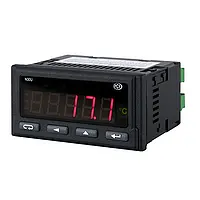
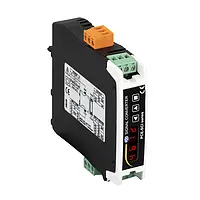
The panel indicator can process several different input signals, such as 0…410/4010 Ohm, -10…+63 mV DC, -13…+13 V DC, -24…+24 mA DC or signals from thermocouples and resistance thermometers. This makes the panel indicator applicable in a wide range of applications. The measured values are shown on the large LED display of the panel indicator.
The panel meter can process several different input signals, such as 0…410/4010 Ohm, -10…+63 mV DC, -13…+13 V DC, -24…+24 mA DC or signals from thermocouples and resistance thermometers. This makes the panel meter applicable in a wide range of applications. The measured values are shown on the large LED display of the panel meter.
The power indicator can process several different input signals, such as 0…410/4010 Ohm, -10…+63 mV DC, -13…+13 V DC, -24…+24 mA DC or signals from thermocouples and resistance thermometers. This makes the power indicator applicable in a wide range of applications. The measured values are shown on the large LED display of the power indicator.
The pressure indicator can process several different input signals, such as 0…410/4010 Ohm, -10…+63 mV DC, -13…+13 V DC, -24…+24 mA DC or signals from thermocouples and resistance thermometers. This makes the pressure indicator applicable in a wide range of applications. The measured values are shown on the large LED display of the pressure indicator.
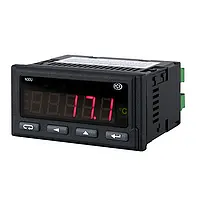
The process indicator can process several different input signals, such as 0…410/4010 Ohm, -10…+63 mV DC, -13…+13 V DC, -24…+24 mA DC or signals from thermocouples and resistance thermometers. This makes the process indicator applicable in a wide range of applications. The measured values are shown on the large LED display of the process indicator.
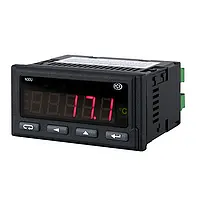
The temperature indicator can process several different input signals, such as 0…410/4010 Ohm, -10…+63 mV DC, -13…+13 V DC, -24…+24 mA DC or signals from thermocouples and resistance thermometers. This makes the digital universal indicator applicable in a wide range of applications. The measured values are shown on the large LED display of the temperature indicator.
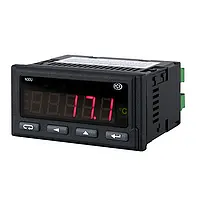
The voltage indicator can process several different input signals, such as 0…410/4010 Ohm, -10…+63 mV DC, -13…+13 V DC, -24…+24 mA DC or signals from thermocouples and resistance thermometers. This makes the voltage indicator applicable in a wide range of applications. The measured values are shown on the large LED display of the voltage indicator.
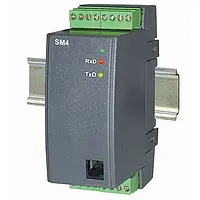
To connect the DIN rail measuring instrument PCE-SM4 via the Modbus machines. This makes it possible to initiate various processes via the H-rail measuring device via a connected HMI.
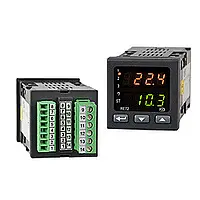
The process controller / temperature controller is a compact PID controller which can be used in a wide range of applications. On the input side, this temperature controller processes the widely used process signals 4 … 20 mA and 0 … 10 V as well as resistance sensors and thermocouples. The temperature controller can be used very flexibly, since different operating modes are available. Besides the simple on / off control with adjustable hysteresis, the digital controller also offers various combinations of the PID control. Thanks to the SMART PID control, this temperature controller achieves the setpoint value very quickly and with a slight overshoot.
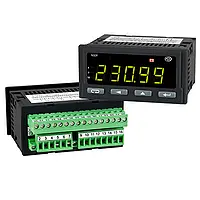
The current signal converter has an adjustable measuring range of 0… 600 V AC/DC and can therefore measure a wide variety of voltages. For example, it is possible to connect the transmitter to the supply line in order to monitor the applied voltage.
The current signal transducer has an adjustable measuring range of 0… 600 V AC/DC and can therefore measure a wide variety of voltages. For example, it is possible to connect the transmitter to the supply line in order to monitor the applied voltage.
The DIN-rail measuring instrument has an adjustable measuring range of 0… 600 V AC/DC and can therefore measure a wide variety of voltages. For example, it is possible to connect the transmitter to the supply line in order to monitor the applied voltage.
The universal signal converter has an adjustable measuring range of 0… 600 V AC/DC and can therefore measure a wide variety of voltages. For example, it is possible to connect the transmitter to the supply line in order to monitor the applied voltage.
The voltage signal converter has an adjustable measuring range of 0… 600 V AC/DC and can therefore measure a wide variety of voltages. For example, it is possible to connect the transmitter to the supply line in order to monitor the applied voltage.
The simple pressure sensor PCE-PS 420 can be used everywhere where simple pressure is to be measured. The measured pressure is provided as a 4 … 20 mA analog value on the pressure sensor.
The temperature indicator has a temperature measuring range of -20 … 60 °C and a humidity measuring range of 0 … 99.9% RH. The readings from the temperature indicator can be read directly on the 2.3" color display.
Temperature measurement
The I/O module PCE-SM4AI has 4 analog inputs for process signals, thermometers etc. All inputs from the I/O module are individually programmable. The I/O module is used to provide analog measurement signals in a Modbus network.
PCE-VS10 is a vibration meter, analyzer or sensor condition monitoring switch used to measure RMS and peak value of vibration velocity or acceleration piezoelectrically. This IP67-rated vibration monitoring switch features a red and green visual warning or alarm with programmable high pass and low pass filters.
The remote maintenance module PCE-SM61 allows you to quickly and easily query your process data via the Internet. Any device with RS485 interface can be connected to the remote maintenance module. The data is retrieved via a web browser and can be carried out simultaneously by the PC, smartphone, tablet, etc., and by several users. In addition to the data query, the remote maintenance module can trigger alarms. The configuration can be done via USB or Ethernet interface.