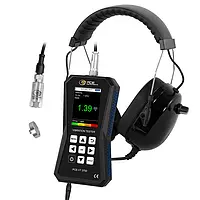
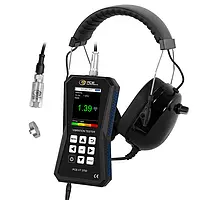
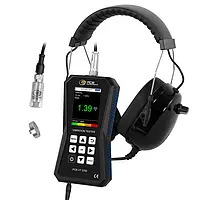
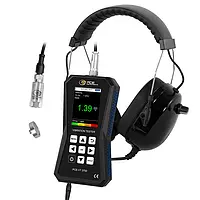
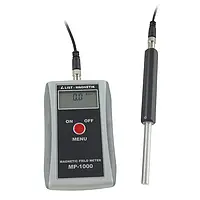
The force gauge is ideal for mobile tensile measurements, such as those carried out by surveyors. Quality materials are used in the manufacture of the tension force gauge. Despite the high measuring capacity, these materials enable a compact design with a low weight.
The PCE-TG 300-NO2 is an ultrasonic thickness gauge for measuring wall thickness. In general, the wall thicknesses of all homogeneous materials can be measured with the ultrasonic thickness gauge. Wall thicknesses under a coating can also be measured with the ultrasonic thickness gauge.
The PCE-TG 300-NO7 is an ultrasonic thickness gauge for measuring wall thickness. In general, the wall thicknesses of all homogeneous materials can be measured with the ultrasonic thickness gauge. Wall thicknesses under a coating can also be measured with the ultrasonic thickness gauge.
The PCE-TG 300-NO5 is an ultrasonic thickness gauge for measuring wall thickness. In general, the wall thicknesses of all homogeneous materials can be measured with the ultrasonic thickness gauge. Wall thicknesses under a coating can also be measured with the ultrasonic thickness gauge.
The PCE-TG 300-NO2 is a thickness gauge for measuring wall thickness. In general, the wall thicknesses of all homogeneous materials can be measured with the thickness gauge. Wall thicknesses under a coating can also be measured with the thickness gauge.
The PCE-TG 300-NO7 is a thickness gauge for measuring wall thickness. In general, the wall thicknesses of all homogeneous materials can be measured with the thickness gauge. Wall thicknesses under a coating can also be measured with the thickness gauge.
The PCE-TG 300-NO5/90 is an ultrasonic thickness gauge for measuring wall thickness. In general, the wall thicknesses of all homogeneous materials can be measured with the ultrasonic thickness gauge. Wall thicknesses under a coating can also be measured with the ultrasonic thickness gauge.
The PCE-TG 300-NO5 is a thickness gauge for measuring wall thickness. In general, the wall thicknesses of all homogeneous materials can be measured with the thickness gauge. Wall thicknesses under a coating can also be measured with the thickness gauge.
The PCE-TG 300-NO5/90 is a thickness gauge for measuring wall thickness. In general, the wall thicknesses of all homogeneous materials can be measured with the thickness gauge. Wall thicknesses under a coating can also be measured with the thickness gauge.
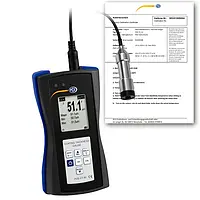
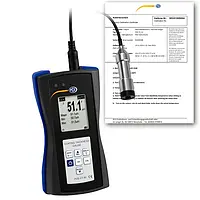
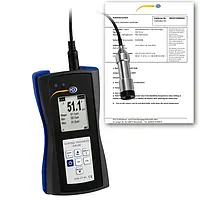
of, for example, plastics, paints and other coatings on ferrous and non-ferrous metals. With a measuring range of up to 5000 µm on ferrous metals, the paint gauge covers a wide range of measuring tasks.
of, for example, plastics, paints and other coatings on ferrous and non-ferrous metals. With a measuring range of up to 5000 µm on ferrous metals, the coating thickness gauge covers a wide range of measuring tasks.
of, for example, plastics, paints and other coatings on ferrous and non-ferrous metals. With a measuring range of up to 5000 µm on ferrous metals, the car measuring device covers a wide range of measuring tasks.
of, for example, plastics, paints and other coatings on ferrous and non-ferrous metals. With a measuring range of up to 5000 µm on ferrous metals, the material thickness meter covers a wide range of measuring tasks.
of, for example, plastics, paints and other coatings on ferrous and non-ferrous metals. With a measuring range of up to 5000 µm on ferrous metals, the material tester covers a wide range of measuring tasks.
, for example, plastics, paints and other coatings on ferrous and non-ferrous metals. With a measuring range of up to 5000 µm on ferrous metals, the automotive tester covers a wide range of measuring tasks.