


£ 27.00
Price excl. VAT &. delivery
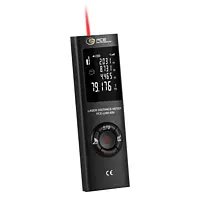
Laser rangefinders allow measuring the distances quickly and easily. Many devices also offer additional functions for the respective application or are designed directly for special applications.
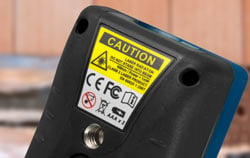 Laser is highly concentrated, high-intensity light with which highly precise cuts can be made. If this light hits the human eye in big amounts, this leads to irreparable damage. Almost all laser rangefinders work with the class II lasers. Class I lasers are either so low in energy that it is possible to look at them for a long time or so well encapsulated that you cannot come into direct contact with the radiation. These are installed in CD players, for example. Class II lasers, such as those installed in the laser rangefinder, include visible lasers with the power of 3 to 10 W. Class II lasers can damage the human eye. Therefore, it is necessary to remember never to look into the direct or reflected laser radiation during the measurement with the laser rangefinder and never to direct the laser beams into the eyes of the others. Class III lasers are divided into a and b. The class IIIa includes the visible lasers above class II and some of the invisible ones, and the class IIIb – those that are even more dangerous ones. If you want to work with class III lasers, you have to take special protective measures.
The measurement of buildings, structures and open spaces is considerably facilitated due to the laser rangefinders. If the measurement data is not immediately transferred to drawings, tables or sketches, the laser rangefinder should at least offer simple calculation functions. Laser rangefinders with two laser units provide a very quick measurement of the length and width of large areas without the necessity to place the device at an end point. The determination of the middle of a distance is also simplified by the laser rangefinder with two lasers. This allows making markings much faster.
Special laser rangefinders for sport and leisure enable the determination of the distances up to approximately 800 m and the speed of the objects that approach or move away in a straight line. Some of these laser rangefinders developed for outdoor activities such as golf, hiking, running, cycling and hunting have a special function for measurements in fog.
The police also use the laser range finders for mobile speed control. The measuring beam of these laser guns must be aligned as parallel to the direction of travel as possible. The laser rangefinder calculates the covered distance and the speed from several individual measurements.
In the industrial production, laser rangefinders are used, for example, to monitor the fill level in silos and containers, to check the dimensions of the raw materials and products and to position the tools and workpieces. The laser range finders for these tasks can continuously measure at the specified time intervals and transmit the measurement data to the alarm devices or controls via one or several interfaces.
 Many laser distance meters can perform calculations with multiple measurements. You can, for example, form sums and differences or calculate the areas of rectangles and the volume of cuboids. If the Pythagoras function is stored in the laser rangefinder, a distance that cannot be measured directly can be determined via two measurements from another point to the two end points sought. To do this, one of the measured distances must form a right angle with the searched distance.
A special application for the laser rangefinders is the speed measurement. Within a short time, these laser range finders determine the speed from the change in distance per unit of time based on several individual measurements.
If the laser rangefinder has two parallel but oppositely directed laser units, this not only increases the range, but also simplifies the detection of the larger areas. Both individual measurements and their sum are displayed. With this laser rangefinder, the middle of a longer distance can be determined quickly and easily by moving the device between the two limit points until both individual distances have the same value.
The laser rangefinders equipped with an inclination sensor can indirectly determine the heights even without the right angle. This means that this laser rangefinder can also calculate the inaccessible distances via the triangular functions if the corresponding distances and angles have been recorded.
Laser rangefinders are equipped with analog, digital or switching outputs to control the production processes. The measured values can be saved and evaluated externally or used directly to regulate the processes. If the laser rangefinder measures and transmits a predetermined limit value, the transport or manufacturing process can be stopped or changed automatically.
Laser rangefinders use the properties of the laser radiation. The word laser that came from Light Amplification by Stimulated Emission of Radiation, means also light amplification caused by the stimulated emission of radiation. Lasers are characterized by parallel radiation of the same frequency and direction with strong beam bundling and high radiation density. For distance measurement, the light focused by the laser range finder is directed at the target point. The part of the reflected radiation is registered by the detector in the laser rangefinder and then evaluated according to the respective measuring principle. Laser rangefinders only need a very small measuring area. The target point is optically marked by the incident light. Target plates can be used in case of the unfavorable ambient light, difficult surfaces and long distances. Outdoor laser glasses help to aim at the measuring points. Laser rangefinders use various methods to determine the distance.
During the measurement of the transit time, the distance is determined by how long it takes for the reflected light to be captured by the detector in the laser range finder. These laser distance meters show larger distances when the light beam passes through the denser layers, because then the runtime increases. The distances in the meter and centimeter range cannot be measured directly with inexpensive components in micro- and nanoseconds. For this reason, one also uses the phase modulation for these laser rangefinders and evaluates the phase shift.
The triangulation principle determines the distance to the measurement object via the angle at which the reflected light hits the sensor in the laser rangefinder. The greater the distance to the measurement object, the smaller the angle between the transmitted and the reflected radiation.
The superposition of waves is called interference. Interference patterns are generated by the amplification or cancellation of the wave crests. Measurement methods that use the superposition of the waves are summarized under the term interferometry. Laser rangefinders that use interferometry can detect the smallest path changes very precisely. Depending on the equipment, different ranges can be covered.