

pH Meter / pH Tester PCE-228S
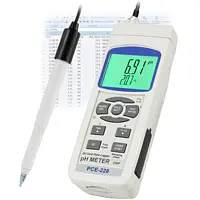
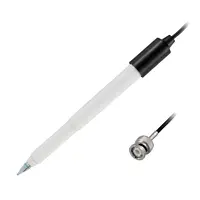
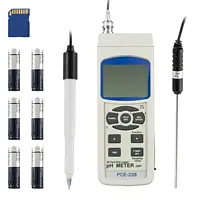
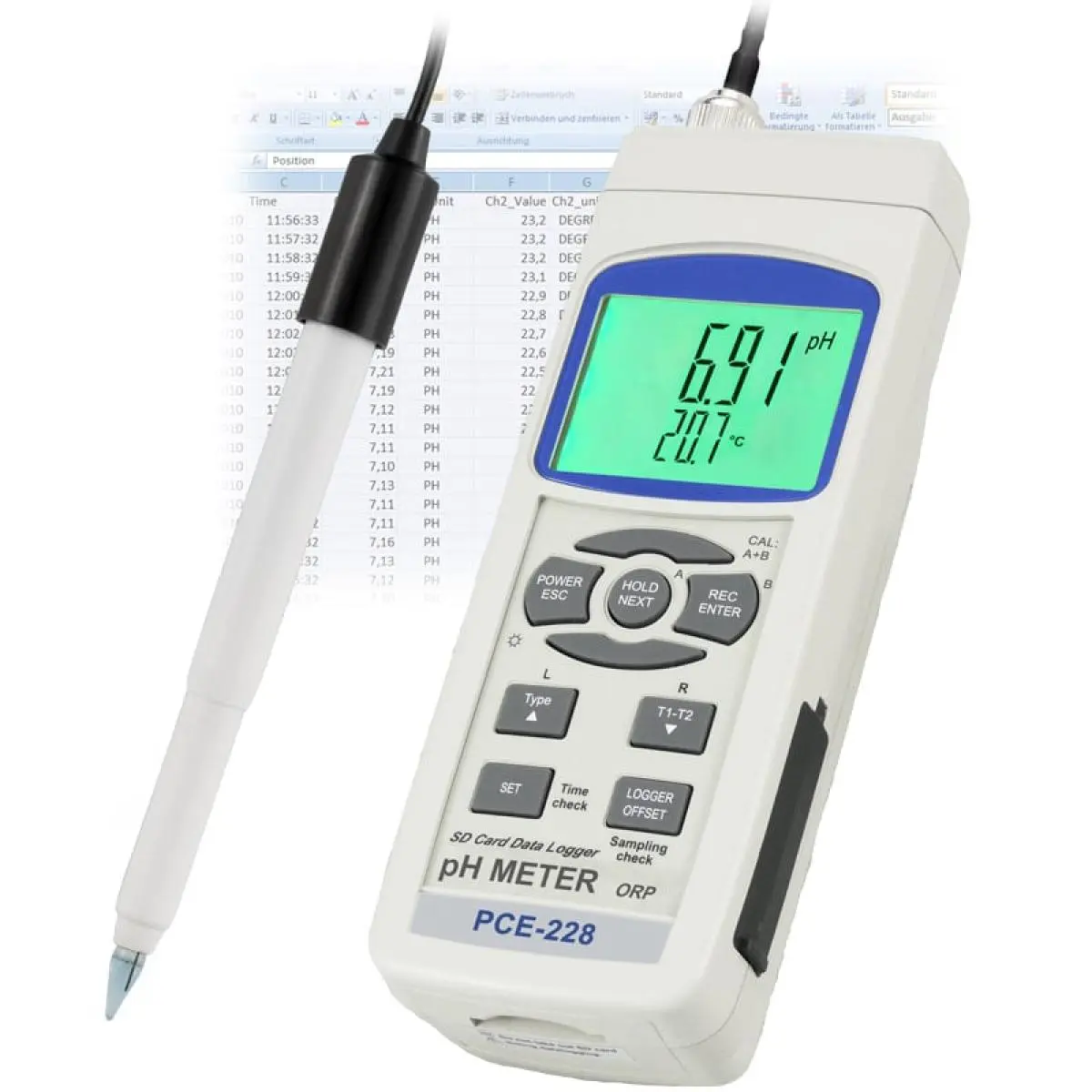
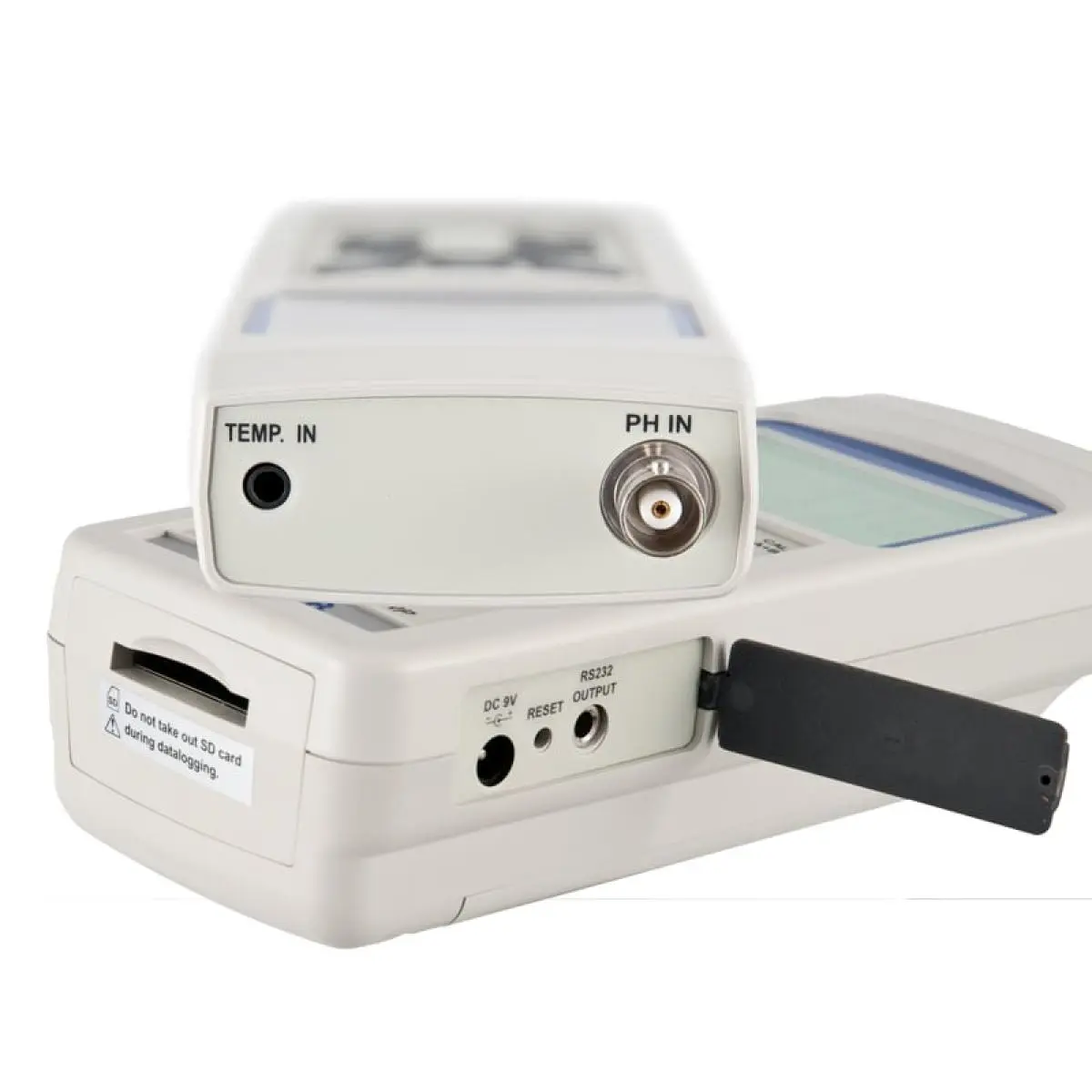
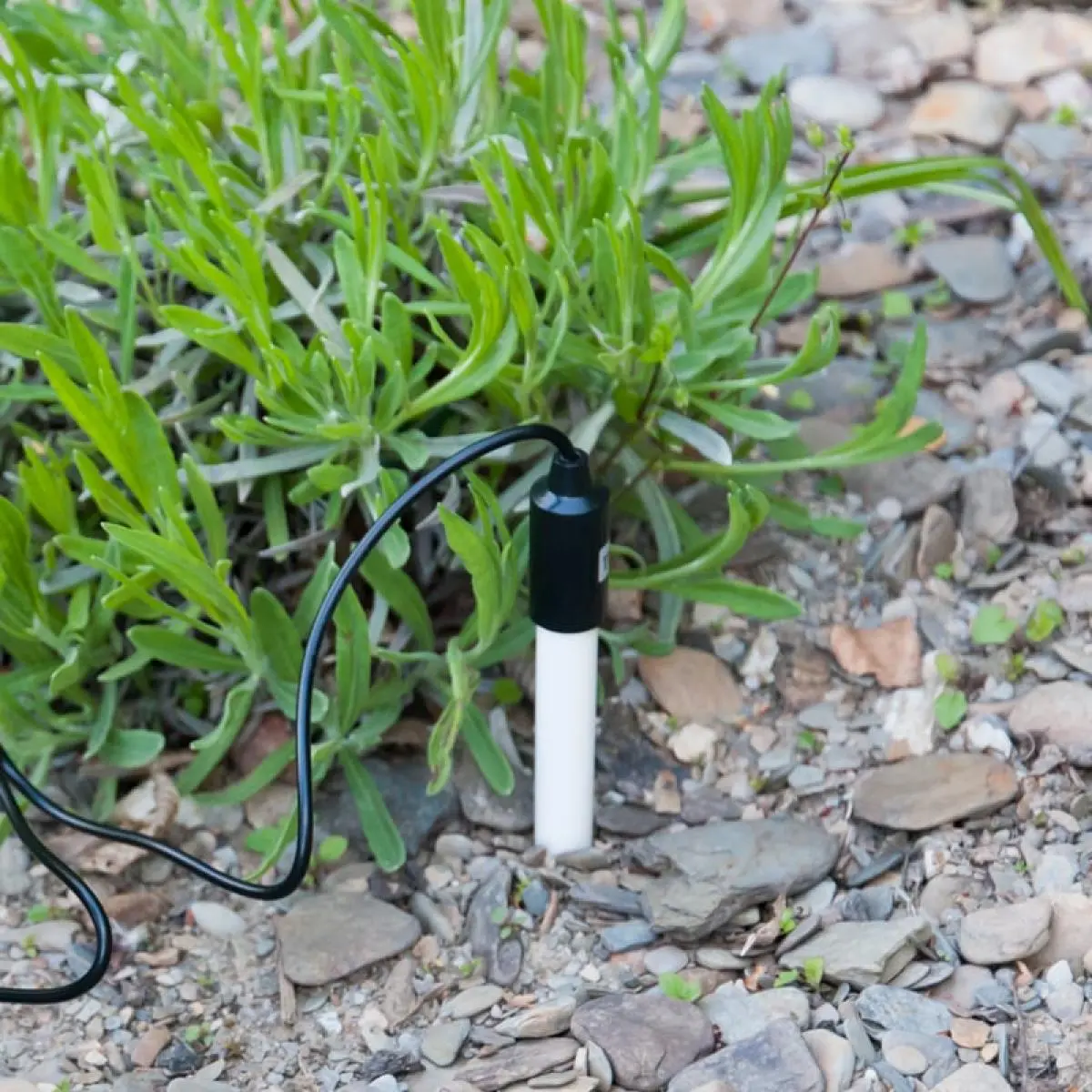
The pH Meter / pH Tester PCE-228S is used to measure the soil pH value. The pH and temperature can be stored directly on the SD card. The special pH electrode of the pH meter PCE-228S is manufactured so that it is possible to measure with the pH meter in loosened soil. Temperature compensation is either manual or automatic via the supplied temperature sensor.
Please always make sure that the measuring principle requires a minimum residual moisture in the soil. Thus, this pH Meter / pH Tester is the ideal solution for the accurate measurement of soil pH, in substrates, for horticultural irrigation solutions used in greenhouses, and also in agricultural products and plants.
The meter is always factory calibrated. A continuous recalibration of the pH meter is carried out by means of the supplied calibration standards (buffer solutions). The calibration data remains stored when the battery is changed. In general, you can simply pierce the electrode into the ground and read the pH directly on the digital display. If you would like to carry out a measurement according to DIN or if you cannot penetrate deep enough into the soil due to soil hardness, then you should prepare a DIN soil solution and use it for the exact measurement.
Application Gardeners
Professional gardeners as well as environmentalists know how much depends on the condition of the soil. Depending on its composition, it may be very fertile, or absolutely inappropriate for cultivation. pH level (acidity) of the soil, together with the temperature, moisture content, and of course amount of light, determine the quality of the soil, in the garden, on the fields, in the greenhouses, winter gardens, on the terrace, flower beds or in the pots at home. pH meter with a thin electrode is applicable anywhere where pH value of a soil sample should be measured. Due to the thin long tip, penetrating the soil is very easy, and the measurement is immediate. The results indicate whether certain measures should be taken to change a too acidic or too alkalic medium in the soil and to adjust it in correspondence with the plans that are growing or will be growing in the soil. Not all kinds of plants require the same soil. And there is no ideal standard which all the gardeners should strive for. Neutral pH for soil is between 6.5 to 7, but there are many agricultural cultures that need 6 and even 5. A correctly prepared soil sample is sufficient for getting a reliable result and making a conclusion about the soil condition. Electrode should be handled with care and possibly not applied in the sample with stones or rock particles, since it may damage the glass. Correct cleaning after measuring procedure and storage allow the same electrode to be applied over a longer time period.
The Importance of the Soil pH In Agriculture
The pH value of the soil is undoubtedly one of the factors that has a decisive influence on the yield of any crop, along with the other more obvious and known factors important for the plants, such as the availability of water or the nutrient content. The matter is that the pH value of a soil may cause certain nutrients and trace elements essential for a particular crop to be present in such a form that they are better absorbed by the plant, or vice versa: an inadequate or not properly controlled soil pH value can cause nutrients which have initially been available in the soil, or which the farmer has subsequently added by means of fertilization, to be present in the form of a chemical compound not absorbable by the plant, and consequently, the plant does not develop optimally. For this reason, as well as because of the inefficient use of expensive fertilizers, the profitability of the farmer can be seriously jeopardized if he does not control the pH of the soil with an accurate pH meter, which allows him to make the pertinent corrective decisions in each particular case. There are several known agronomic techniques that allow correcting the pH of the soil and adapting it to the optimal conditions for the crop. It must be taken into account that for each crop there is the most suitable range of the soil pH value, within which it is convenient and recommended to work in order to reach the optimum yield. Although, as a rule, the majority of the agricultural crops yield better in the soils with the pH close to neutral or slightly acid, there are crops that are adapted and especially indicated for more acidic or more basic soils, different from the neutral pH.
pH Value Measurement in Soil
The soil pH is a distinctive mark of its acid or base content. The pH of a soil, as in all the other aqueous systems, is affected by natural buffer systems. The determination takes place either in a suspension (extraction procedure) of soil in a neutral salt solution (0.01 N calcium chloride or potassium chloride) - lab measurement method. Here, since the absorbed H + ions are replaced by the CaCl2-ions, the pH measured in such a way is about 0.3-1.0 units below the pH, which is measured in purely aqueous suspensions. However, not all the data in the literature are corrected accordingly.
Practical example: pH measurement in soil with a soil extraction solution - Laboratory measurement method according to DIN 19684 Part 1
between pH 2 to pH 9
PCE-228
pH electrode with spherical membrane, refillable or gel-filled, fabric or ceramic diaphragm
Required equipment 1 electrode stand
1 large-volume beaker (>500 ml),
1 magnetic or glass rod for stirring
Carrying out a pH measurement - experimental method:
Make the soil mix sample (air-dry clay) taken from various representative sampling probes. Remove foreign bodies (inter alia stones, roots). Slightly loosen the soil with hands.
Suspension with distilled water as the solvent
This method detects the normal acidity of the soil. The existing bound acid ions present in the soil matrix are not detected.
Put 260 ml of distilled water to 100 g of a soil mix sample and stir / shake this suspension for 5 minutes. After this, the sample is left still for minimum 2 hours, but not longer than 24 hours.
Suspension with 0.01 M CaCl2 solution
Take 75 ml of soil and mix it with 300 ml of 0.01 M CaCl2 solution (0.01 M = 1.11 g of anhydrous calcium chloride or 1.47 g CaCl2 * 2 H2O for 1 liter distilled water), stir very intensely and let it stand without stirring for at least 60 minutes. Stir the sample shortly before the measurement and immerse the pH electrode and temperature into the fluid to be measured.
The suspension with 0.01 M CaCl2 solution, the easily replaceable hydrogen ions are also incidentally detected, as these are exchanged from the bound sample matrix by the cations. This determination method is very close to the longer-term process in the soil. That is why, the pH of this suspension is 0.5 to 1.0 pH units lower than the pH of the aqueous soil suspensions. Take note of the measurement value with 0.01 pH accuracy when the measured value is constant.
Measured value indication in suspension:
- With distilled water: pH (distilled water) x.xx (y ° C) pH (distilled water) 7.22 (23 ° C)
- With CaCl2: pH (CaCl2) x.xx (y ° C) pH (CaCl2) 7.22 (23 ° C)
Please note that during any pH measurement the temperature constancy between the liquid under measurement and the electrode can take place. Finally, after the measurement clean the pH electrode of contaminants by rinsing with distilled water. pH sensor should not be affected mechanically. Then keep the electrode in (STORAGE-Solution).
PCE Instruments offers:
pH calibration solutions: PCE-PH47-x pH4,00 and pH 7.00 in the bottle sizes x = 250
and x = 500
STORAGE Solution: PCE SSO 500 Storage solution for pH sensors
Magnetic stirrer: PCE-MSR 100 or PCE-MSR 110
Depending on soil testing method (DIN 19684 Part 1.2 / 77, ISO 10390) the amount / volume of sample and added extraction solution vary.
Practical example: pH measurement in soil - direct measurement method
between pH 2 to pH 9
PCE PH20S or PCE-228 with pH electrode PCE-PH-ES
or similar pH electrode with a conical membrane, refillable or gel filled with ceramic diaphragm
1 soil test solution
1 stick for hole making,
Carrying out a pH measurement - Experimental method:
Drill the soil approximately 20 cm deep and loosen it slightly. Remove the hard objects (for example, stones) out of the drill hole. In case of dry soil / ground moisten it with a few ml of a soil test solution.
Put the pH electrode and the temperature sensor into the wet drilling opening until the diaphragm is completely covered with a moist soil sample.
Take a record of a measurement rounded with 0.1 pH accuracy record when the measured value is constant.
Measured value indication: pH x.x (y°C) for example, pH 7.2 (23°C)
Please note that during any pH measurement the temperature constancy between the liquid under measurement and the electrode can take place.
Finally, after the measurement clean the pH electrode of contaminants by rinsing with distilled water. pH sensor should not be affected mechanically. Then keep the electrode in STORAGE-Solution.
Note
In case of this measuring method it goes about local detection of soil pH. It is therefore appropriate to conduct the pH measurement at several different insertion sites to detect the natural metric differences of the soil. The pH of a soil affects the absorption of nutrients and the presence of microorganisms.
Particularly in wet peat with the decomposition stage >H6 / H7, it is recommended to carry out the pH measurement according to the extraction – laboratory measurement methods.
Preferred pH range of different plant species
FRUIT PLANTS
Apple 5-6,5
Appricot 6-7
Pear 6-7,5
Grapefruit 6-7,5
Pomegranate 5,5-6,5
Grapevine 6-7
Cherry 6-7,5
Lemon 6-7
Peach 6-7,5
Plum 6-7,5
Walnut 6-8
Orange 5-7
Nectarine 6-7,5
VEGETABLES AND HERBS/ SPICES
Artichokes 6,5-7,5
Pepper 6-7
Asparagus 6-8
Tomatoes, early 4,5-6
Barley 6-7
Tomatoes, late 4,5-6
Beans 6-7,5
Brussels sprouts 6-7,5
Pumpkin 5,5-7,5
Carrots, early 5,5-7
Rice 5-6,5
Carrots, late 5,5-7
Soybeans 5,5-6,5
Cucumber 5,5-7,5
Spinach 6-7,5
Aubergine 5,5-7
Strawberries 5-7,5
Lettuce, Pflücksalat 6-7
Corn 6-7,5
Sugar beet 6-7
Melons 5,5-6,
Onions 6-7
Water melons 5,5-6,5
Grass, general 6-7,5
GARDEN PLANTS AND FLOWERS
Acacia 6-8
Privet 5-7,5
Bear Claw 6-7
Magnolia 5-6
Amarant 6-6,5
Daffodils 6-8,5
Bougainvillea 5,5-7,5
Oleander 6-7,5
Dahlias 6-7,5
Erika 4,5-6
Rose plant 5,5-7,5
Fuchsia 5,5-7,5
Primroses 6-7,5
Enzian 5-7,5
Rhododendron 4,5-6
Gladioli 6-7
Roses 5,5-7
Hellebore 6-7,5
Stonecrop 6-7,5
Hyacinth 6,5-7,5
Sunflowers 5-7
Iris 5-6,5
Tulip 6-7
Wacholder 5-6,5
Violet 5,5-6,5
| pH | |
| Measuring range | 0 ... 14 pH |
| Resolution | 0,01 pH |
| Accuracy | ±(0.02 pH +2 digits) |
| Redox | |
| Measuring range | -1999 ... +1999 mV |
| Resolution | 1 mV |
| Accuracy | ±(0.5 % +2 digits) |
| Temperature | |
| Measuring range | 0 ... 65 °C |
| Resolution | 0,1 °C |
| Accuracy | ±0.5 °C |
| Electrode | |
| Designation | PCE-PH-ES |
| Measuring range | 0 ... 14 pH |
| Temperature range | 5 ... 60 °C |
| Application | pH measurements: for soils and ground |
| Reference electrolyte | Ag/AgCl |
| Shank material | Epoxid |
| Shank length | 160 mm |
| Shank diameter | 12 mm |
| Cable length | 1 m |
| Connection | BNC |
| General technical data | |
| Measuring functions | MIN, MAX, HOLD |
| Temperature compensation | - automatic 0 ... 65 °C - manual 0 ... 100 °C with temperature sensor removed |
| Display type | LCD with backlight |
| Display size | 2,6 Inch |
| Storage medium | SD card |
| Storage capacity | 4 GB |
| Memory capacity (additional information) | up to 16 GB SD card possible |
| Storage interval from | 1 s |
| Storage interval to | 9 min. |
| Interface | RS232 |
| Number of calibration points | 3 |
| Calibration | automatic |
| Menu language | English |
| Protection class (device) | IP20 |
| Power supply | 9 V DC |
| (Rechargeable) battery | 6 x 1,5 V AA battery , Alkali-manganese |
| Capacity | 3000 mAh |
| Operating conditions | 0 ... 50 °C , 0 ... 85 % RH |
| Storage conditions | 0 ... 50 °C , 0 ... 85 % RH |
| Dimensions ( L x W x H ) | 190 x 68 x 45 mm |
| Weight | 261 g |


 [zoom]
 [zoom]
 [zoom]
 [zoom]
 [zoom]


