Measuring methods in the distance measuring devices
Distance meter / Rangefinders mostly relate the measured distance to the international base unit of meters. Anglo-Saxon units such as inch (Zoll in German), foot and yard are still common in Great Britain, the USA and former British colonies, and interestingly, the word “zoll” is still used by the installers in the German-speaking world. Below you will find a brief overview of the different measuring methods used in the distance meters.
For rangefinders, the first important selection criterion is the measuring range, 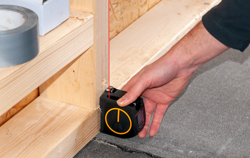 which means whether the distances of less than one millimetre, for example, in the case of coatings, or of a few kilometres, for example, when measuring the way to school, should be detected. Another criterion is the accessibility of the measuring section:
When choosing a distance meter, you should also pay attention to the information on the measurement accuracy and the requirements for the ambient conditions. A high resolution of the display is not identical with a high measuring accuracy of the distance measuring device. Distance meters that are used in the official traffic are – in accordance with the Measuring and Verification Act § 3 measuring device-specific definitions, para. 22. a) and b) and - Measuring and Verification Ordinance § 1 application area for measuring devices and sub-devices ", only to be used in a calibrated version. In particular, if the measured values are to be used in the context of expert reports for public prosecutor or judicial or in arbitration proceedings, the parties involved must use the calibrated distance meters. Stationary distance meters for fixed installation are particularly suitable for measurements on moving objects and are also suitable for production control due to their short response time and measurement value transmission. For example, fill levels, thicknesses of the application and component positions can be measured during the production and the data passed on.
Distance meters with a measuring wheel are also suitable for curved routes, for example in road and path construction, for the detection and recording of the braking marks during accident recordings and for checking the length of school ways. The distances are covered with the measuring wheel on a rod and the number of revolutions is determined with a counter wheel. If the diameter of the measuring wheel is 1m, 372 revolutions correspond to a length of 372m. Part revolutions are also captured and displayed. But measuring wheels can be used not only for measuring distances in the field but also for length measurements in the production process. Depending on the object to be measured, different surfaces (smooth, knurled, nubbed, corrugated, O-ring) and different materials (aluminium, polyurethane, Hytrel [TPE] nitrile [NBR]) are possible for the impeller.
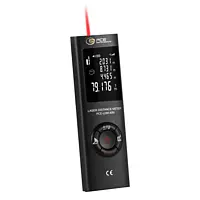
Laser distance meters send sharply focused light of a certain wavelength to the 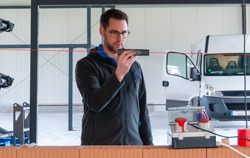 measuring point using a laser diode. There the light is reflected, hits the receiver next to the laser diode and is then evaluated.
Because of the measuring principle, most laser rangefinders can only measure the distances from about 5 cm. Only a very small measuring surface is required for the measurement, and it increases with the increasing distance. The control of the target point is possible due to the red-light spot. To make it easier to see this red-light spot, especially at long distances outdoors, laser vision glasses and target plates are recommended.
Many laser distance measuring devices can not only measure and save the distances but also calculate areas and volumes from several measured values , for example, sums or differences. The tilt measurement function is also very helpful, as due to it not only the roof pitches can be3 measured, but also the difficult-to-assess distances can be determined.
For the application in industry, there are laser rangefinders with analogue, digital or switching outputs that can be used to control the transport or manufacturing processes.
Special laser rangefinders can determine the change in distance and, correspondingly, in speed from numerous measurements per unit of time to (e.g. laser guns for speed monitoring in the road traffic).
Problems can occur with obliquely targeted and some other surfaces. Then the target boards are recommended:
Air layers with different temperatures can also falsify the measurement value. Most laser distance measuring devices work with class 2 lasers and may be used without further protective measures if neither deliberate looking inside for a long-term application, nor the repeated looking at the laser radiation or mirror reflected laser radiation is required.
Ultrasonic distance meters determine the distance to an object through the time duration, which it takes for the sound to travel to an object and back. The path length can then be calculated from the speed of the sound of the material through which the sound has passed. In the ultrasonic rangefinders, the impacting sound cannot be displayed. Some devices therefore have an additional laser display that shows the target point, but not the areas from which the sound is really reflected. Objects in the vicinity of the route or near the target point can reflect the sound and lead to incorrect measurement results. Also, for the obliquely targeted surfaces the result can be falsified. Because of the type of sound propagation, the devices are usually limited to the measuring distances of up to max. 20m. Hard material and liquids can be easily detected with the ultrasonic distance meters. Soft materials such as felt, cotton wool, foams or coarse-grained bulk goods "swallow" or scatter the sound so that they do not reflect well. At high temperatures of the measuring surface, it may lead to the deflection of the radiation, because of the heat convection of the surrounding air. Many distance warning devices in the automotive field work with the ultrasonic rangefinders/distance meters. Ultrasonic rangefinders can also be used for level monitoring. This measurement is independent of the material properties such as density and moisture of the product. The most common form of application is the measurement from above, during which the distance to the surface of the material is measured. However, there are also such sensors that detect the sound propagation directly in the medium, in single-walled containers and liquids, which enables the measurements from below or on the side of the container. With special ultrasonic rangefinders, the material thicknesses of materials – or the distance from one surface to another – can be determined. To do this, one needs to know the speed of sound specific to the material and to place the sensor directly on the object to be measured.
On metallic bottom layers, with the help of the special sensors, one may measure the thickness of overlying layers – or the distance from the coated surface to the surface of the base material. Two different measuring principles are used here:
