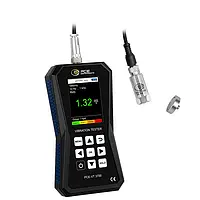
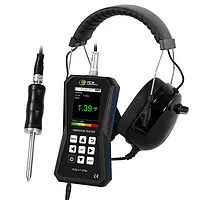
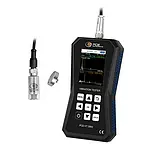
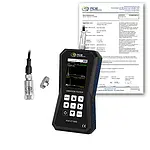
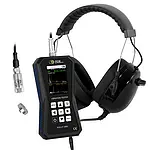
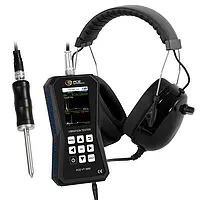
The accelerometer is used as a hand-held measuring device for the individual assessment of vibrations on machines and systems. With the help of this accelerometer, the actual state can easily be determined on site. Thus, corresponding changes can be made directly on site after the measurement.
Frequency range: 10 Hz … 1 kHz
Measures speed, distance, acceleration in metric units only
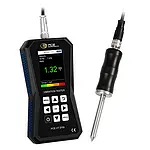
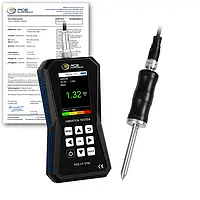
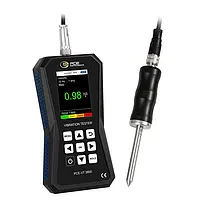
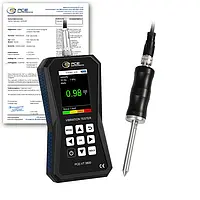
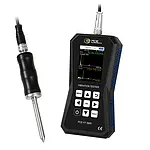
The accelerometer is suitable for relative measurements on various machines. With the 45 mm long needle probe, you can access hard-to-reach places in machines and motors. For this reason, this accelerometer is used for rapid measurement of imbalance and for checking bearing and gear conditions.
Frequency range: 10 Hz … 1 kHz
Measures speed, distance, acceleration in metric units
The accelerometer is suitable for relative measurements on various machines. With the 45 mm long needle probe, you can access hard-to-reach places in machines and motors. For this reason, this accelerometer is used for rapid measurement of imbalance and for checking bearing and gear conditions.
Frequency range: 10 Hz … 1 kHz
Measures speed, distance, acceleration in metric units
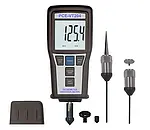
The PCE-VT 204 is a multifunction handheld accelerometer device with the ability to accurately measure both rotation and vibration. An ideal tool for the testing and inspection of machine parts and components such as motors, transmissions, gears, gear boxes and wheels, this multi-purpose instrument measures revolutions per minute (RPMs) as well as three-axis vibration, i.e., speed or velocity, displacement and acceleration.
Vibration measurement: Velocity or speed, acceleration and displacement
RPM measurement: Contact / mechanical and noncontact / optical
The PCE-VT 204 is a multifunction handheld accelerometer device with the ability to accurately measure both rotation and vibration. An ideal tool for the testing and inspection of machine parts and components such as motors, transmissions, gears, gear boxes and wheels, this multi-purpose instrument measures revolutions per minute (RPMs) as well as three-axis vibration, i.e., speed or velocity, displacement and acceleration.
Vibration measurement: Velocity or speed, acceleration and displacement
RPM measurement: Contact / mechanical and noncontact / optical
The accelerometer is ideal for maintenance workers to quickly check vibrating parts, machines and systems. This accelerometer shows the vibration acceleration, vibration velocity and vibration displacement directly on the display. The measurement unit can be switched between the metric system and imperial units.
The accelerometer is ideal for maintenance workers to quickly check vibrating parts, machines and systems. This accelerometer shows the vibration acceleration, vibration velocity and vibration displacement directly on the display. The measurement unit can be switched between the metric system and imperial units.
The accelerometer is ideal for maintenance workers to quickly check vibrating parts, machines and systems. This accelerometer shows the vibration acceleration, vibration velocity and vibration displacement directly on the display. The measurement unit can be switched between the metric system and imperial units.
The accelerometer is ideal for maintenance workers to quickly check vibrating parts, machines and systems. This accelerometer shows the vibration acceleration, vibration velocity and vibration displacement directly on the display. The measurement unit can be switched between the metric system and imperial units.
The accelerometer is ideal for maintenance workers to quickly check vibrating parts, machines and systems. This accelerometer shows the vibration acceleration, vibration velocity and vibration displacement directly on the display. The measurement unit can be switched between the metric system and imperial units.
The Accelerometer is ideal for maintenance workers to quickly check vibrating parts, machines and systems. This Accelerometer shows the vibration acceleration, vibration velocity and vibration displacement directly on the display. The measurement unit can be switched between the metric system and imperial units.
Measuring ranges
The accelerometer is ideal for maintenance workers to quickly check vibrating parts, machines and systems. This accelerometer shows the vibration acceleration, vibration velocity and vibration displacement directly on the display. The measurement unit can be switched between the metric system and imperial units.
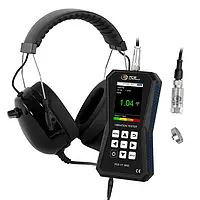
The accelerometer is the ideal companion for checking vibrating parts, machines and systems. With the external vibration sensor on the accelerometer, the vibration displacement up to 3.9 mm, the vibration velocity up to 399.9 mm/s and the vibration acceleration up to 399.9 m/s² can be determined.
The accelerometer is the ideal companion for checking vibrating parts, machines and systems. With the external vibration sensor on the accelerometer, the vibration displacement up to 3.9 mm, the vibration velocity up to 399.9 mm/s and the vibration acceleration up to 399.9 m/s² can be determined.
The accelerometer is the ideal companion for checking vibrating parts, machines and systems. With the external vibration sensor on the accelerometer, the vibration displacement up to 3.9 mm, the vibration velocity up to 399.9 mm/s and the vibration acceleration up to 399.9 m/s² can be determined.
The accelerometer is the ideal companion for checking vibrating parts, machines and systems. With the external vibration sensor on the accelerometer, the vibration displacement up to 3.9 mm, the vibration velocity up to 399.9 mm/s and the vibration acceleration up to 399.9 m/s² can be determined.
The accelerometer is the ideal companion for checking vibrating parts, machines and systems. With the external vibration sensor on the accelerometer, the vibration displacement up to 3.9 mm, the vibration velocity up to 399.9 mm/s and the vibration acceleration up to 399.9 m/s² can be determined.
The accelerometer is the ideal companion for checking vibrating parts, machines and systems. With the external vibration sensor on the accelerometer, the vibration displacement up to 3.9 mm, the vibration velocity up to 399.9 mm/s and the vibration acceleration up to 399.9 m/s² can be determined.
The accelerometer is an ideal measuring device for fast and precise checking of vibrating parts, machines and systems. Various measurement parameters are available for the accelerometer, such as RMS, peak, peak-peak and crest factor.
The accelerometer is an ideal measuring device for fast and precise checking of vibrating parts, machines and systems. Various measurement parameters are available for the accelerometer, such as RMS, peak, peak-peak and crest factor.
The accelerometer is an ideal measuring device for fast and precise checking of vibrating parts, machines and systems. Various measurement parameters are available for the accelerometer, such as RMS, peak, peak-peak and crest factor.
The accelerometer is an ideal measuring device for fast and precise checking of vibrating parts, machines and systems. Various measurement parameters are available for the accelerometer, such as RMS, peak, peak-peak and crest factor.
The accelerometer is an ideal measuring device for fast and precise checking of vibrating parts, machines and systems. Various measurement parameters are available for the accelerometer, such as RMS, peak, peak-peak and crest factor.
The accelerometer is an ideal measuring device for fast and precise checking of vibrating parts, machines and systems. Various measurement parameters are available for the accelerometer, such as RMS, peak, peak-peak and crest factor.
The Accelerometer enables precise monitoring of vibrations in industrial machinery. The Accelerometer measures acceleration, velocity, and displacement with high accuracy.
The Accelerometer is a handy measuring device for vibration analysis and machine monitoring in industry, production and maintenance. The Accelerometer records the three most important vibration parameters – acceleration, velocity and displacement – and displays them simultaneously on the screen.
The Accelerometer is a handy measuring device for vibration analysis and machine monitoring in industry, production and maintenance. The Accelerometer records the three most important vibration parameters – acceleration, velocity and displacement – and displays them simultaneously on the screen.
The Adhesion Tester is a portable, hand-operated device that measures the force required to pull a specific test diameter of coating from the substrate using hydraulic pressure. The measured pressure is displayed on the 5-inch touch screen and represents the adhesion strength of the coating to the substrate. In addition, the Adhesion Tester offers a USB interface for easy transfer of the measurement data to external devices.
electronically controlled hydraulic pump
various measuring head sizes available
adjustable pulling speed, limit and holding time
graphical measurement history
memory in csv file format
incl. 20 mm measuring heads
standard(s): GB/T 5210, ASTM D4541/D7234, ISO 4624/16276-1
PCE-CPT 20 is a Adhesion Tester, or surface coating flexibility testing device, used for testing the formability, ductility, adhesion and elongation of paints, lacquers, varnishes, powder and protective coatings on sheet metal. Used in manufacturing production, paint shop and quality control applications, the Adhesion Tester aids in determining coating strength, durability and elasticity.
Tests surface coatings on metal sheets 0.3 to 1.25 mm thick
The Adhesion Tester PCE-CRC 10 is designed to determine the quality of the adhesion of coatings. The Adhesion Tester is suitable for thin, thick or tough coatings on all surfaces. Since the adherence of paintings and other coatings is a crucial product and quality characteristic for their protective effect, adhesion testers are used in a wide range of industries.
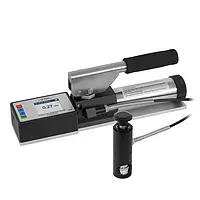
The Adhesion Tester is a portable, hand-operated device that measures the force required to pull a specific test diameter of coating from a substrate using hydraulic force. The measured force is shown on the LCD and represents the adhesion strength of the coating to the substrate. In addition, the Adhesion Tester offers a USB interface for easy transfer of the measurement data to external devices.
manually controlled hydraulic pump
various measuring head sizes available
memory in CSV file format
incl. 20 mm measuring heads
standard(s): GB/T 5210, ASTM D4541/D7234, ISO 4624/16276-1
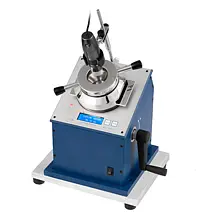
The Adhesion Tester is a compact bench-top meter with an integrated load cell for the precise measurement of forces within the range 0 ... 500 N. The Adhesion Tester was specially developed for peel tests and enables a comprehensive assessment of the processing quality.
The Adhesion Tester is a compact bench-top meter with an integrated load cell for the precise measurement of forces within the range 0 ... 500 N. The Adhesion Tester was specially developed for peel tests and enables a comprehensive assessment of the processing quality.
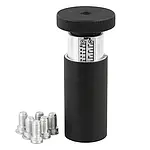
The simple design and an absolutely straightforward operation make it possible for the practitioner to use the adhesion tester as an instrument for daily adhesion tests. Using adhesive with rapid curing, the tests can be performed by the user in the shortest possible time.
Breakout force: 200 kg
Diameter of base dolly, mm: 15.1 (№ 1) and 19.5 (№ 2)
Specific breakout force, MPa: Dolly №1 up to 10 MPa (100) Dolly №2 up to 6 MPa (60)
The Adhesion Tester is a portable electronic measuring device designed for the precise measurement of tensile stress in threads and linear materials. It is used in the wire and cable, textile and chemical fiber, metal and carbon fiber sectors, as well as in other industries. Stored data can be transferred from the Adhesion Tester to PC software.
PCE Instruments offers a wide range of stock products. However, despite an extensive selection of stock product offerings, sometimes a custom product is required to satisfy the specific requirements of a new, groundbreaking or special application.
Are you looking for custom test instruments?
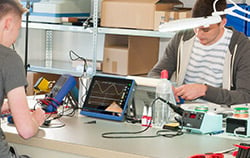
Look no further than PCE Instruments. The DIN EN ISO 9001-certified PCE Product and Development Company GmbH produces customized test instruments tailored to meet the unique needs of a diverse customer base. By capitalizing on the expert knowledge and extensive experience of PCE’s industry-leading engineers and technicians to create custom-built test instruments, customers obtain measuring devices designed specifically for the task at hand.
Throughout the design, development and production process, PCE's engineers and technicians work hand-in-hand with each customer to ensure the final test instrument exceeds expectations. Specifications are clearly defined from the start of the project. Sensors, microprocessors and other electronic components are sourced from high-quality suppliers. Software is written to best support the customer's systems, processes and procedures. Qualified calibration laboratories are tasked with verifying the measurement accuracy of the custom test instrument, and rigorous testing is conducted to make certain that the device will function properly under the anticipated operating conditions.
If you are interested in pursuing the creation of a custom test instrument designed to accommodate an unusual or highly specialized measuring task, please contact the friendly and knowledgable staff at info@industrial-needs.com or +44 (0) 161-464902-5 for PCE Instruments UK, or at info@pce-americas.com or +1 (561) 320-9162 for PCE Americas Inc.
















 engineers and technicians to create custom-built test instruments, customers obtain measuring devices designed specifically for the task at hand.